Choosing the right power supply is an important part of designing a reliable LED signage system. An undersized power supply may run continuously at its maximum capacity, while an incorrectly matched voltage can damage LED modules.
For channel letters, light boxes and other illuminated signage, the basic calculation is straightforward — but there are several factors that should be considered before selecting the final power supply.
1. Start with the Total LED Power
First, check the rated power consumption of the LED module. This information should always come from the product specification or datasheet.
The basic formula is:
Total LED Power = Number of LED Modules × Power per Module
For example, if a signage project uses 50 LED modules, and each module consumes 1.2W:
50 × 1.2W = 60W
The total LED load is therefore 60W.
If the project uses different types of LED modules or additional LED strips, calculate the power consumption of each section and add them together.
2. Allow Sufficient Power Supply Headroom
It is generally recommended not to operate a power supply continuously at 100% of its rated capacity.
A practical approach for LED signage is to allow approximately 20% headroom.
The calculation can be made as:
Required Power Supply Capacity = Total LED Load × 1.2
Using the example above:
60W × 1.2 = 72W
Therefore, the power supply should have a rated capacity of at least 72W.
The next available standard power supply size should then be selected, such as a 75W or 100W power supply, depending on the installation requirements.
Allowing headroom can help reduce continuous loading and provide additional capacity for normal operating variations and temperature conditions. Industry signage guidance commonly recommends keeping the continuous load below approximately 80% of the power supply rating.
3. Match the Power Supply Voltage to the LED Modules
The output voltage of the power supply must match the rated voltage of the LED modules.
For example:
12V LED Module → 12V DC Power Supply
24V LED Module → 24V DC Power Supply
Never select a power supply based only on wattage. The voltage must also be correct.
Using the wrong voltage can cause poor performance or potentially damage the LED modules. Always check the product specification before installation.
4. Don't Forget Voltage Drop
Power supply capacity is only one part of the system.
For larger signs or installations with long cable runs, voltage drop can also affect LED performance.
If the cable between the power supply and the LED modules is too long or the cable size is insufficient, the voltage at the far end of the circuit can decrease.
This may result in:
Uneven brightness
Dimmer modules at the end of a run
Colour variation
Reduced system performance
For larger signage projects, the wiring layout, cable length and cable size should therefore be considered together with the power supply selection.
5. Consider the Installation Environment
The operating environment should also be considered when selecting a power supply.
For example:
Indoor signage
A standard indoor-rated power supply may be suitable, depending on the installation conditions.
Outdoor signage
The power supply should be appropriately protected against moisture and environmental conditions. The required IP rating depends on where and how the power supply is installed.
Temperature is another consideration. Power supplies installed inside enclosed sign cabinets or exposed to high ambient temperatures may require additional capacity or derating.
Example: Power Supply Calculation for LED Modules
Let's look at a simple channel letter application.
LED modules: 50 pcs
Power per module: 1.2W
Module voltage: 12V
Step 1 — Calculate the LED load
50 × 1.2W = 60W
Step 2 — Add 20% headroom
60W × 1.2 = 72W
Step 3 — Select the power supply
Choose a suitable 12V DC power supply rated above 72W, such as a 75W or 100W model, subject to the specific installation requirements.
This simple calculation provides a starting point, but the final selection should also consider cable length, voltage drop, operating temperature, installation environment and the manufacturer's specifications.
Quick Formula
For most constant-voltage LED module applications:
Total LED Load (W)
= Number of Modules × Watts per Module
Recommended Minimum Power Supply (W)
= Total LED Load × 1.2
For example:
100 × 1.2W = 120W
120W × 1.2 = 144W
A suitable standard power supply above 144W would therefore be required, subject to the installation conditions.
At DV LED, we provide LED modules and signage lighting solutions for channel letters, light boxes and illuminated signage, with options for different sign depths, brightness requirements and installation environments.
Need help selecting the right LED module and power supply for your signage project? Contact DV LED for technical support.
→LED Sign Modules Australia
→LED Power Supply


 LED Knowledge
How to Calculate the Right Power Supply for LED Modules
LED Knowledge
How to Calculate the Right Power Supply for LED Modules 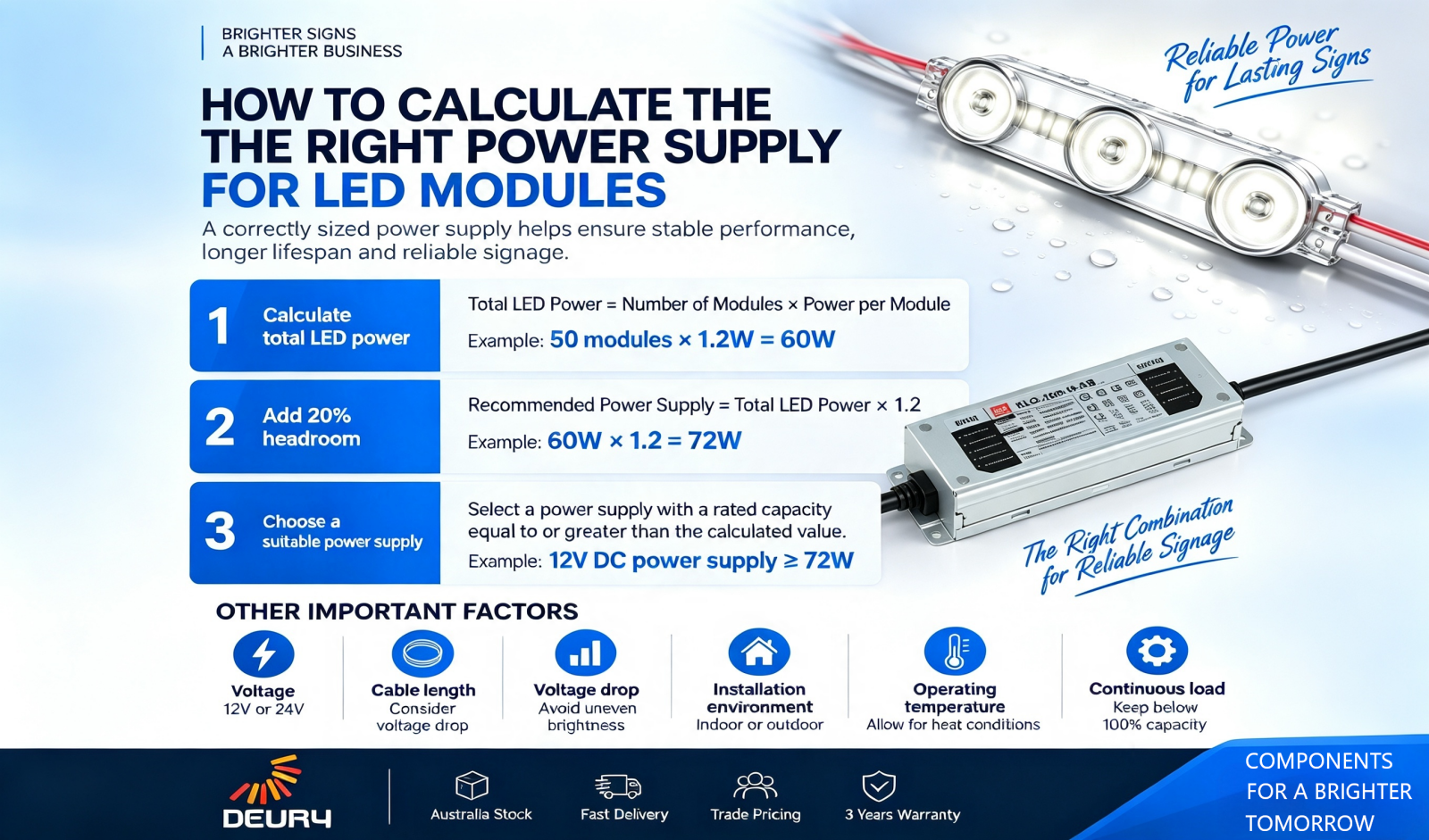



 04 5984 4358


